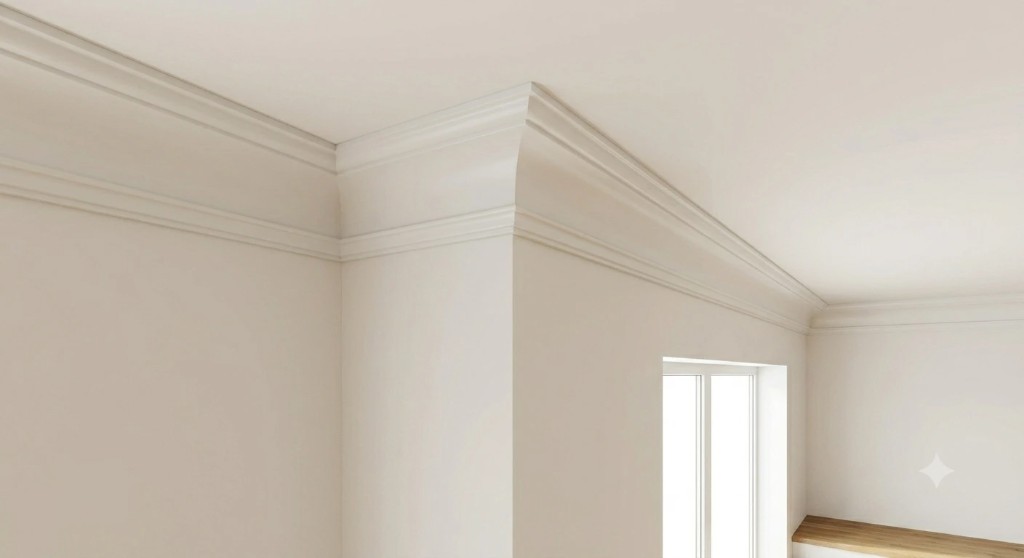
Defeating Out-of-Square Corners: Calculating Compound Miters for Interior Trim
There is a running joke among finish carpenters that a perfect 90-degree corner has never actually existed in residential construction. Framing shifts, drywall tape, and layers of joint compound conspire to turn every single corner in your home into an irregular angle—typically anywhere from 88 to 92 degrees.
If you set your miter saw to a generic 45-degree setting to cut crown molding for these corners, you will be left with massive, visible gaps that even the thickest bead of caulk cannot hide.
Why Crown Molding Fails Simple Miter Math
Unlike baseboards or flat casing, crown molding does not sit flat against the wall. It rests at a diagonal tilt (known as the spring angle, typically 38 or 45 degrees), bridging the ceiling and the wall simultaneously.
Because the wood is tilted in three-dimensional space, cutting it requires a compound cut: you must pivot the saw blade horizontally (miter angle) and tilt the saw blade vertically (bevel angle) at the exact same time.
How to Map an Imperfect Room
To achieve flawless, seamless joints, you cannot rely on guesswork.
- Purchase an inexpensive digital protractor or angle finder.
- Place the arms flat against the actual walls right at the ceiling line to capture the true corner angle.
- Input that precise decimal reading into our calculator above along with your molding's specific spring angle.
Our engine utilizes advanced trigonometric formulas to output the exact, un-rounded miter and bevel settings for your specific compound miter saw down to a fraction of a degree.
Upside Down and Backwards: The Golden Rule of Cutting
If you choose to cut your molding flat on the saw bed using our compound calculations, remember that the ceiling side of the molding must face the fence of the saw, and the wall side must rest flat on the table.
Pro tip: Many professionals prefer to cut crown molding "nested." This involves placing the molding upside down against the saw fence at its exact spring angle. This trick turns a complex compound cut into a simple single miter cut, but it requires highly disciplined spatial awareness to avoid cutting the wrong end of the board.