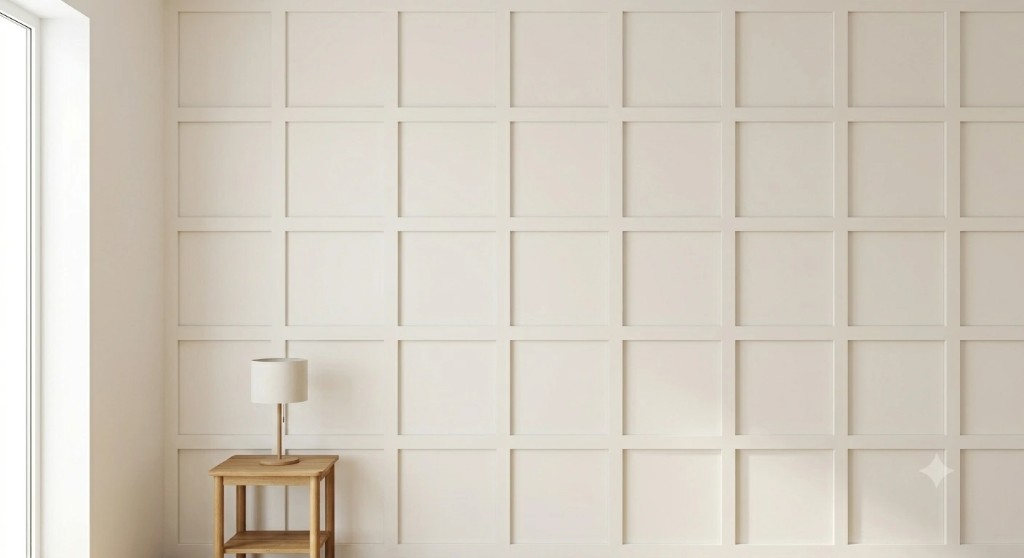
Mastering Accent Wall Geometry: The Definite Guide to Flawless Board and Batten Spacing
The biggest lie in interior DIY is that an accent wall is just a weekend paint job with some extra wood stuck to it. Anyone can nail a piece of MDF to drywall, but the difference between a high-end designer home and an awkward, amateurish renovation comes down to a single element: optical symmetry.
When amateurs look at a blank wall, they assume they can simply divide the total wall width by their desired number of panels. This basic math is a trap. It completely ignores the actual thickness of the trim boards themselves (the battens). If you fail to account for batten thickness, your final panel on the right side will end up noticeably narrower or wider than the rest, throwing off the room's entire focal weight.
The Secret Math Behind Symmetrical Panels
To achieve a visually balancing grid, you must subtract the combined width of all vertical boards from your total wall length before calculating the gaps.
Panel Spacing = (Total Wall Width − (Batten Width × Number of Battens)) ÷ (Number of Battens − 1)
By inputting your physical parameters into our calculator above, you protect yourself from cumulative measurement creep—a phenomenon where being off by just 1/16 inch on your first three panels leaves your last panel completely deformed.
Navigating Real-World Obstacles: Outlets and Windows
Rarely will you encounter a completely blank, uninterrupted wall. You will almost certainly have to contend with light switches, electrical outlets, or window trim.
Pro tip: Never allow a vertical batten to partially overlap an electrical outlet box. It looks unprofessional and creates a fire hazard by preventing the outlet cover plate from sitting flush.
If your mathematical layout places a board directly over an outlet, you have two choices:
- Shift your entire layout left or right by a few inches.
- Alter your panel count (e.g., switching from 5 panels to 6 panels) to change the spacing frequency and force the boards to clear the obstacle.
Material Selection: MDF vs. Solid Wood
For interior accent walls that will be painted, MDF (Medium-Density Fiberboard) trim boards are vastly superior to raw lumber. MDF does not possess grain, knots, or natural warping patterns. It stays perfectly flat, absorbs paint uniformly, and will not expand or contract with seasonal humidity changes.
If you are planning a stained wood look, select a high-grade hardwood like Poplar or Oak. Avoid cheap construction-grade framing pine from the home center; it is highly prone to twisting, bowing, and bleeding sap through your final finish coat.